
01 / UNDERSTAND
What is an empathy map?
An empathy map organises research around what someone says, thinks, does and feels in a particular situation. It helps a team discuss an experience without losing the relationship between a person’s account, their actions and the context.
It is a synthesis tool, not a way to read minds. Thoughts and feelings may be reported by the participant or interpreted by the team; keep that distinction visible. The four part format is one common version. Other versions, including XPLANE’s canvas, add different prompts.
Why use empathy mapping?
A transcript contains more than memorable quotes. Someone may explain a goal, describe a workaround and hesitate at a decision. Putting these fragments together can reveal a question that separate notes hide.
The map gives a team a compact reference for deciding what to investigate. Its value is not agreement about a person’s personality. It is a clearer account of what is supported, what is uncertain and what to do next.
When to use an empathy map
USE IT WHEN
After interviews or observation, when the team needs to discuss a specific experience.
Before a design decision, when different interpretations of the same behaviour are competing.
When research notes need a concise summary with visible gaps.
When to choose another method
Use User Interviews first if there is no research to synthesise. An assumption map must be labelled as such.
Use Customer Journey Map when the order of events is central to the problem.
Use Personas when the question concerns recurring differences across people and situations.
What you’ll need
Choose a person and a bounded situation. Gather relevant notes or recordings with permission to use them. Remove identifying details from shared materials and assign source codes. Decide which decision the map should inform. A blank canvas, a facilitator and access to the underlying accounts are enough to begin; a decorative portrait is not necessary.
What goes into an empathy map?
Keep the elements that help answer your question and support a decision.
Whose experience is represented, at what moment and with which goal?
Exact words from an account, with their source and context.
Reported thoughts or clearly labelled interpretations to investigate.
Actions, distinguishing observation from a participant’s description.
Reported emotions in context, keeping inferred feelings tentative.
Source identifiers, uncertainty and questions that remain open.
02 / PUT IT INTO PRACTICE
How to create an empathy map
Keep evidence and assumptions distinct. Revisit your work when new information changes your understanding.
01
Bound the situation
Choose one person or a justified grouping and state the question.
Focus on submitting a repair request, not the tenant’s whole relationship with housing.
02
Extract the evidence
Separate quotes, actions and interpretations before placing notes.
Keep the online preference, the submission and the later call as separate entries.
03
Build the map
Place notes in the four lenses and attach source identifiers.
Mark the reason for the call as unknown until the account supports it.
04
Read across the lenses
Look for a tension or missing context that matters to the decision.
Online submission and a follow up call may indicate an unresolved need.
05
Challenge the explanation
Compare at least two plausible accounts and ask what would distinguish them.
Was the call about acknowledgement, arranging access or something else?
06
Choose the next step
Record a research question or design proposal, its owner and review point.
Check the purpose of the call before testing a receipt and response window.
Example: requesting a home repair
Illustrative scenario: all details below are invented. A tenant uses a housing provider’s website to report a leaking tap. In the fictional session, they say they want to report it online, then telephone after submitting the form.
The map records the call as an action. The tenant’s stated concern is whether anyone received the request. The team provisionally interprets this as uncertainty about acknowledgement, while keeping another possibility open: the tenant may need to negotiate access to the property. Neither explanation is established by the call alone.
The design proposal is to show a receipt, a reference number and an expected response window. Before building it, the team asks what the tenant needed from the call and checks whether access arrangements remain unresolved. The goal is to resolve the need, not simply reduce telephone contacts.

03 / BELOW THE SURFACE
Below the surface: two explanations, one action
A gap between words and actions does not prove inconsistency in the person. In the repair example, wanting an online route and making a call can both be reasonable. The website may accept a request without providing the information needed to act on it.
01 / OBSERVATION
What happened?
Describe the action without assigning a motive.
02 / ALTERNATIVE
What else fits?
Which other explanation is consistent with the same evidence?
03 / DECISION
What would change?
What new information would lead to a different design choice?
Keep two plausible explanations alive. A receipt might address uncertainty about submission but do nothing about arranging entry. If the team assumes a confidence problem, it may add reassuring language while leaving the practical obstacle untouched.
Ask a neutral question such as “What were you hoping would happen when you called?” Compare the answer with the interaction record. Decide what evidence would make you change the design proposal. This comparison is an editorial prompt developed for this guide, not a validated psychological model or a claim about the tenant’s motives.
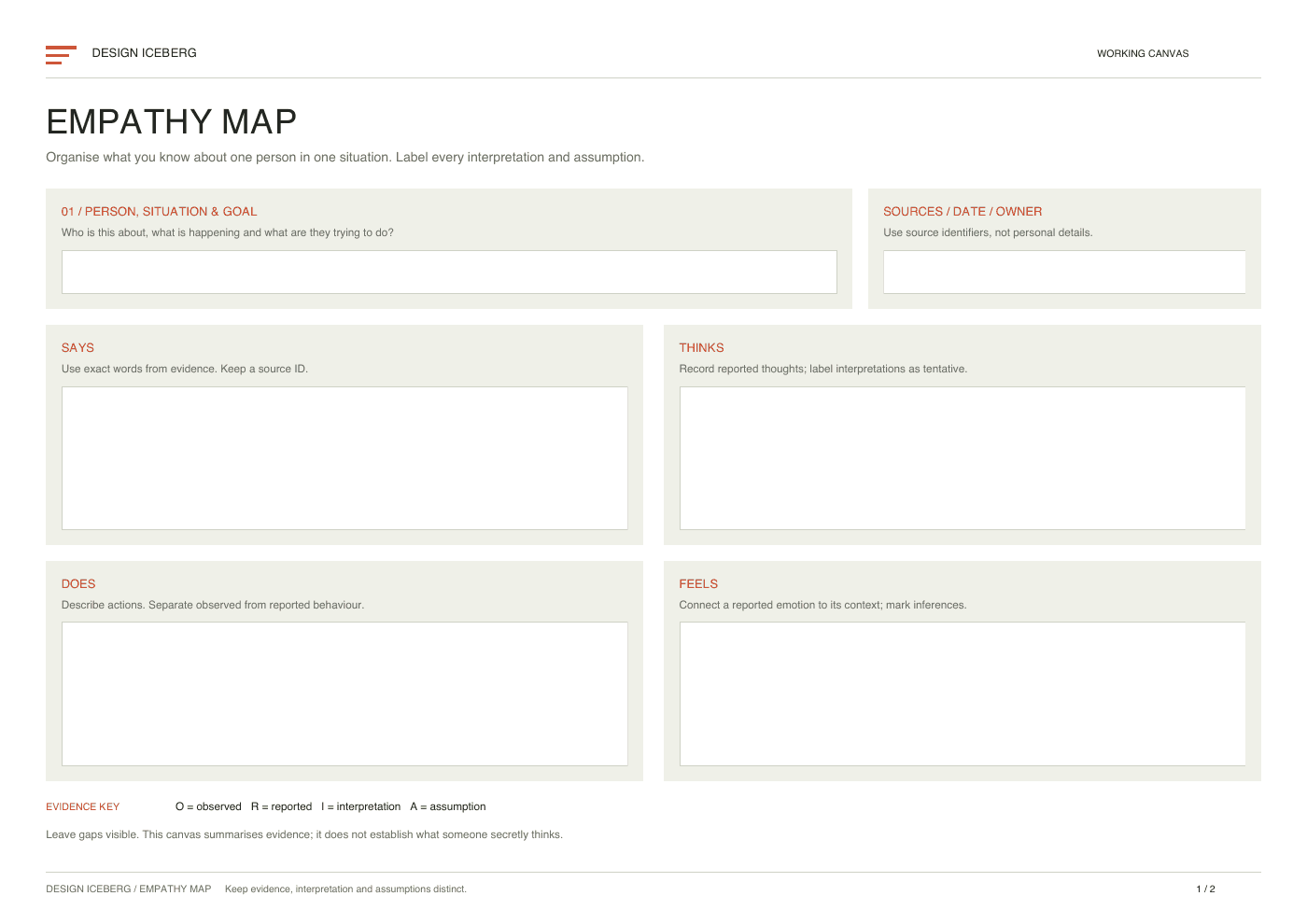
Empathy Map template
Use the first page to capture the person, situation and four lenses. Mark notes as observed, reported, interpreted or assumed, with source identifiers beside them. The second page examines one tension, compares alternative explanations and records a question, design option and follow up.
The PDF has 13 editable fields. Open it in a PDF reader that supports forms and save a working copy. Use a separate map when the situation or person changes substantially.

Practical tips
Write one claim per note so evidence and interpretation can be separated.
Preserve the participant’s wording when recording a quote.
Let the map stay uneven if the evidence is uneven.
Return to the source when the team disagrees about what a note means.
Common mistakes
Filling empty quadrants with invented emotions.
Combining incompatible situations into a single average user.
Treating an observed action as proof of its cause.
Turning every uncertainty into a feature request before investigating it.
What you’ll get
A readable summary of an experience and the limits of the team’s understanding. The next step should connect one supported need to one decision or research question. Keep the date, sources and unresolved explanations with the map so it can be revised when new evidence arrives.