01 / UNDERSTAND
What is swot analysis?
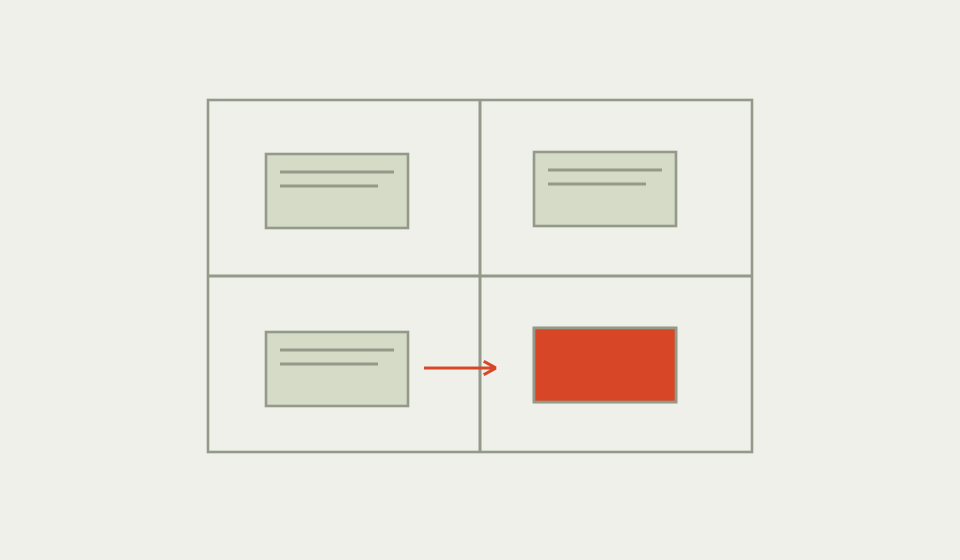
SWOT analysis organises factors around a strategic question into strengths, weaknesses, opportunities and threats. Strengths and weaknesses concern the organisation or proposition being examined; opportunities and threats concern its external environment.
The four boxes are a starting point for reasoning, not a strategy by themselves. The useful work is connecting relevant factors to possible actions and checking the assumptions behind those actions.
Why use SWOT Analysis?
A team may discuss a promising opportunity without examining whether it has the capacity to respond. SWOT brings internal capability and external conditions into the same conversation. It can expose a mismatch that would be difficult to see in an isolated list of benefits.
When to use it
USE IT WHEN
A strategic option needs a balanced examination of internal and external factors.
A team is considering a new service, market or operating arrangement.
Different assumptions about readiness need to become explicit.
When to choose another method
Use User Interviews when customer needs are mostly assumed.
Use Business Model Canvas to examine the wider operating and commercial model.
Use detailed market or financial analysis when the decision depends on evidence beyond a workshop.
What you’ll need
Choose one decision and timeframe. Bring evidence about capabilities, constraints, customers and external conditions. Include perspectives beyond the immediate project team. Define the organisational boundary: a partner’s capability is not automatically an internal strength that your team controls.
What the method needs
Keep the elements that help answer your question and support a decision.
Internal capabilities or resources relevant to the decision.
Internal limitations that could restrict the option.
External conditions that could support a useful direction.
External conditions that could undermine it.
02 / PUT IT INTO PRACTICE
How to turn a SWOT analysis into action
Keep evidence and assumptions distinct. Revisit your work when new information changes your understanding.
01
Frame the decision
State the option and the time horizon. Avoid a general assessment of everything the organisation does.
Examine extending evening opening, not whether the library is good.
02
Gather factors with evidence
Record concrete claims and their sources. Keep opinions visibly provisional.
Distinguish reported demand from a team belief about demand.
03
Check internal and external boundaries
Ask who controls each factor and whether the label fits the chosen scope.
A nearby partner’s space may be available only under an agreement.
04
Connect factors to options
Explain how a capability could address an opportunity or how a weakness increases exposure to a threat.
Trusted staff could support a pilot, but limited cover may constrain its duration.
05
Challenge the attractive option
Look for assumptions, contrary evidence and conditions that could reverse the recommendation.
Would the service still work during absence or a seasonal demand change?
06
Choose a next action
Record the option, evidence gap and review point. Assign investigation or a bounded trial.
Test a limited schedule before committing to a permanent expansion.
Example: considering evening library sessions
Fictional scenario: a small library is considering evening sessions. Its strengths include established community relationships and experienced staff. Limited staff cover is a weakness. A proposed local evening programme creates an opportunity, while uncertain building access arrangements are a threat.
The team connects the factors rather than counting them. Trusted staff could support a small pilot, but the same people already cover daytime operations. The opportunity therefore depends on an operating arrangement that has not been secured.
A reasonable next step is to verify access and staffing, then investigate demand for a limited trial. The illustration contains invented conditions and does not demonstrate that longer hours would be viable or valued.

03 / BELOW THE SURFACE
Below the surface: the same strength can create exposure
A positive factor is not beneficial under every condition.
BOUNDARY
Which factors can we actually control?
Clarify partners and external conditions.
DEPENDENCY
When does a strength become fragile?
Check concentration and continuity.
ACTION
What follows from the combination?
Write a reasoned option, not a box count.
Strong relationships held by one experienced colleague can make a service effective and fragile at the same time. If the capability cannot be shared, absence may interrupt the very advantage the team relies on. Examine the conditions that make a strength dependable.
For the library, ask which relationships are institutional and which depend on a particular person. Consider how an evening pilot would change that dependency. The issue is not whether the factor belongs in one box or two, but what it implies for the proposed action.
This editorial check resists a false balance sheet of positives and negatives. One critical dependency can matter more than several attractive strengths. Explain the causal reasoning instead of treating the number of entries as a score.
SWOT Analysis companion worksheet
The first page provides four evidence labelled quadrants for a defined decision. The second connects selected factors to an option, dependency and next check. This original worksheet supports reasoning beyond the initial list.


Practical tips
Keep the decision and timeframe visible.
Connect factors before recommending an action.
Common mistakes
Filling boxes with vague claims such as great team.
Counting strengths as if they cancel threats.
Calling an unsupported possibility a market opportunity.
What you’ll get
A clearer account of an option’s conditions and risks. Use the analysis to choose a next investigation or bounded action, then revise it as those conditions change.