01 / UNDERSTAND
What is the Value Proposition Canvas?
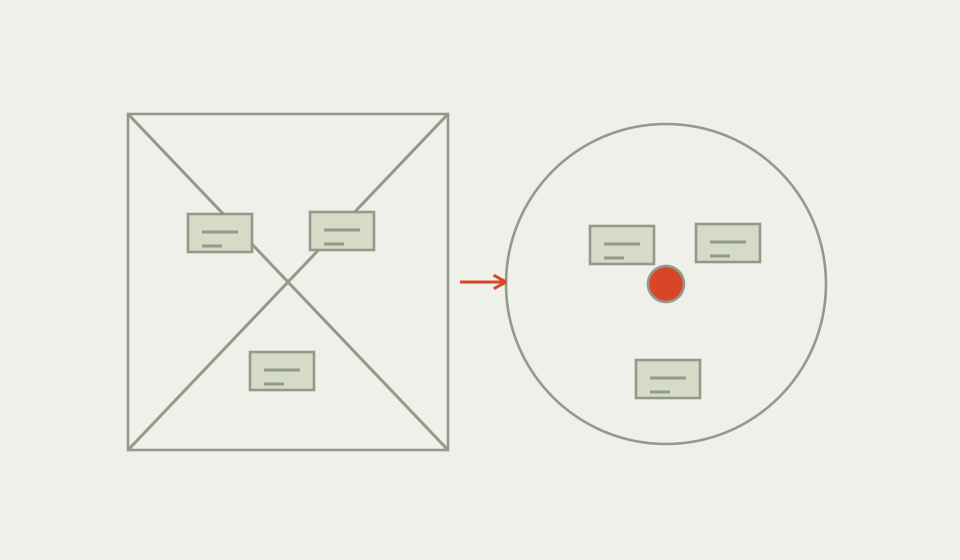
The Value Proposition Canvas connects what a customer is trying to achieve with the value an offer proposes to provide. Strategyzer’s tool separates a customer profile from a value map, making the proposed fit visible.
It is useful before refining a proposition or deciding which benefits deserve attention. Filling the canvas does not demonstrate demand. The connections describe claims that need evidence from people and their circumstances.
Why use Value Proposition Canvas?
Teams often explain an offer through its features and assume the benefits are obvious. This canvas requires a more specific account: which difficulty does a feature reduce, for whom, and in what situation? It can expose an attractive capability that does little for the customer’s actual decision.
When to use it
USE IT WHEN
An offer has many features but an unclear customer benefit.
A team needs to focus on one segment rather than satisfy everyone.
Different interpretations of customer value are pulling a concept apart.
When to choose another method
Use User Interviews if the customer profile is mostly conjecture.
Use Business Model Canvas to examine delivery arrangements and commercial sustainability.
Use Usability Testing when the question concerns completing a task with an interface.
What you’ll need
Choose one segment and a relevant situation. Gather accounts of actual attempts, current alternatives and constraints. Separate statements supported by research from assumptions. Include someone who understands delivery so that the offer does not promise a benefit the service cannot provide.
What the method needs
Keep the elements that help answer your question and support a decision.
What the person is trying to accomplish in a specific situation.
Difficulties, unwanted consequences or risks around that job.
Outcomes or benefits the person would value.
The elements of the proposed offer.
How the offer might reduce a particular difficulty.
How it might produce a valued outcome.
02 / PUT IT INTO PRACTICE
How to use the Value Proposition Canvas
Keep evidence and assumptions distinct. Revisit your work when new information changes your understanding.
01
Describe the situation
Write the segment and the event that brings the need into focus. Keep the profile independent of your solution.
For a repair service, start with arranging a repair, not using its app.
02
Build the customer profile
Record jobs, pains and gains with evidence references. Distinguish a reported difficulty from the team’s interpretation.
A missed visit may concern lost income, not merely inconvenience.
03
Choose what matters
Identify needs important enough to shape the offer. Note whose perspective supports the priority.
Do not use the team’s enthusiasm as a proxy for customer importance.
04
Describe the value map
Connect each relevant part of the offer to the difficulty or benefit it addresses.
An arrival update only reduces uncertainty if it is dependable.
05
Challenge the match
Look for unsupported promises, unaddressed needs and benefits that create new burdens.
Check whether constant notifications demand more attention than they save.
06
Investigate the weakest connection
Specify the observation that would strengthen or challenge the value claim. Choose a suitable research or prototype activity.
Test whether a scheduling promise helps someone plan, not just whether they like its wording.
Example: making a repair visit predictable
Fictional example: a repair service is considering live technician tracking. The customer job is to get a fault repaired without unnecessarily missing work. The proposed profile includes an uncertain arrival time as a pain and a workable plan for the day as a gain.
Live tracking is one possible offer. Another is a reliable appointment window with an early warning when it cannot be met. The canvas connects both to the same need, making them comparable rather than treating tracking as the inevitable answer.
The team would test whether people can make a workable plan with each approach, then examine the operational conditions needed to keep the promise. No preference or demand is established by this invented example.

03 / BELOW THE SURFACE
Below the surface: relief can create another burden
A benefit should be examined across the whole situation, not only where the feature appears.
VALUE
Which outcome matters here?
Keep the customer’s situation explicit.
BURDEN
What new work does the offer require?
Consider attention, coordination and disclosure.
FIT
Does the benefit survive that burden?
Compare alternatives through the same scenario.
Live tracking may reduce uncertainty while requiring someone to keep checking a phone. The service has then moved part of the coordination work to the customer. Ask what new work comes with the promised relief.
Compare the benefit with the attention, disclosure, planning or support it requires. A person may value a less precise but dependable commitment more than detailed information they must constantly interpret.
For this guide, treat that comparison as an editorial check on fit. It is not another official canvas element. Record the burden alongside the proposed gain and test both in the same scenario.
Value Proposition Canvas companion worksheet
The companion worksheet keeps the six canvas concepts visible and adds a second page for examining one value claim. It is an original Design Iceberg worksheet, not the official Strategyzer canvas, which is linked below.


Practical tips
Keep customer evidence separate from proposed features.
Compare different ways to provide the same benefit.
Common mistakes
Writing pains solely to justify an existing feature.
Treating an attractive promise as proof of customer demand.
Ignoring the work required from the customer.
What you’ll get
A clearer account of the value offered to one segment and a next question to investigate. Revise the proposition when evidence changes the need or the cost of meeting it.