01 / UNDERSTAND
What is brainstorming?
Brainstorming is a collaborative method for generating possible responses to a defined question. Participants contribute ideas and develop alternatives before the group evaluates them. The immediate result is a set of possibilities, not a validated solution.
In design work, its value depends on the question and the perspectives in the room. Separate generating ideas from choosing a direction. Otherwise, an early preference can close the discussion before different approaches become visible.
Why use Brainstorming?
A team can agree that something needs improving while imagining only one way to improve it. Brainstorming makes alternative responses explicit, giving people something concrete to compare.
It cannot replace understanding the problem. Start with User Interviews or other relevant evidence when the need itself is unclear. Use How Might We to turn that understanding into a useful question before inviting solutions.
When to use it
USE IT WHEN
You understand a need but want to explore different ways of responding.
Several roles hold knowledge that should inform possible solutions.
The team is treating its first idea as the only available option.
When to choose another method
Investigate the problem first when there is little evidence about the people or situation.
Use individual sketching when participants need uninterrupted time to develop ideas.
Use Usability Testing when the question concerns whether an existing design works in practice.
What you’ll need
Bring a concise brief: who needs what, in which context, and what is known. Distinguish genuine constraints from assumptions about how the service must work. Invite people with relevant perspectives, nominate a facilitator and prepare a space where everyone can contribute.
Choose an accessible format. Allow written, spoken or sketched contributions and make sure remote participants can read and add ideas. Explain how the output will be used before the session begins.
What a brainstorming session needs
Keep the elements that help answer your question and support a decision.
A bounded challenge that leaves more than one response possible.
Relevant observations, needs and constraints, with their sources.
A way for every participant to contribute without competing for airtime.
One understandable proposal per note, with a short explanation.
Space to combine ideas or propose a different mechanism.
Explicit criteria and a follow up action after generation ends.
02 / PUT IT INTO PRACTICE
How to run a brainstorming session
Keep evidence and assumptions distinct. Revisit your work when new information changes your understanding.
01
Frame the challenge
State the person, situation and desired change without specifying the solution.
How might we help visitors find the correct library collection desk? Avoid asking which sign to design.
02
Share the evidence and boundary
Review what is known and mark assumptions. Explain constraints that cannot be changed in this exercise.
The illustrative brief describes different wording in collection emails and building signs. The entrance cannot move.
03
Generate initial ideas
Give people quiet time to record their own responses, then invite contributions without evaluating each one.
Possible ideas include matching language, a route preview and a staff welcome point.
04
Develop different approaches
Ask participants to build on ideas and deliberately explore another way to address the same need.
Instead of another message, could a person collect the book at the desk they already recognise?
05
Clarify and group the options
Make each idea understandable before grouping. Preserve differences that affect how the proposal would work.
Matching labels and moving the collection point address the same difficulty through different mechanisms.
06
Choose what to investigate
After generation, compare options against the need and constraints. Record uncertainty, an owner and the next check.
Prototype a revised email and route cue, while checking the operational implications of changing the collection point.
Example: finding the library collection desk
This is an illustrative scenario, not a record of research. A library team explores a hypothetical mismatch between the phrase ‘collection desk’ in an email and ‘reservations’ on a building sign.
The session produces several possible responses: consistent wording, a preview of the route, a welcome point staffed at busy times and collection at the main service desk. These are design proposals, not demonstrated improvements.
The facilitator groups the options by what they change: information, assistance or the service arrangement. The team chooses a small prototype of the email and route cue because it can examine the wording assumption directly. It keeps the alternative collection arrangement visible for an operational review rather than discarding it as inconvenient.
The next study asks relevant visitors to find the desk using the proposed information. The session alone cannot establish that the change will help.

03 / BELOW THE SURFACE
Below the surface: count mechanisms, not notes
A wall full of ideas can still represent a narrow exploration. Different colours, wording or channels may all rely on the same assumption about what people should do.
MECHANISM
What actually changes?
Describe how the idea is expected to help, beyond its label or channel.
SHARED ASSUMPTION
What do these ideas take for granted?
Identify a premise that several proposals depend on.
NEXT EVIDENCE
What would justify choosing this direction?
Name a check that can challenge the expected benefit.
In the library example, a larger sign, an email reminder and a printed map all ask visitors to navigate the existing arrangement more successfully. They may be useful, but they leave the arrangement itself untouched. Moving collection to a familiar desk changes who must adapt.
Before choosing, ask what each proposal changes: the information available, the support offered, the sequence of work or the responsibility placed on the person. These are prompts for this example, not an exhaustive taxonomy or a validated scoring model.
A small set of genuinely different approaches may reveal more than many cosmetic variations. Keep both the preferred option and one meaningful alternative long enough to examine their assumptions. Popularity in the workshop is evidence of participant preference, not evidence of customer value.
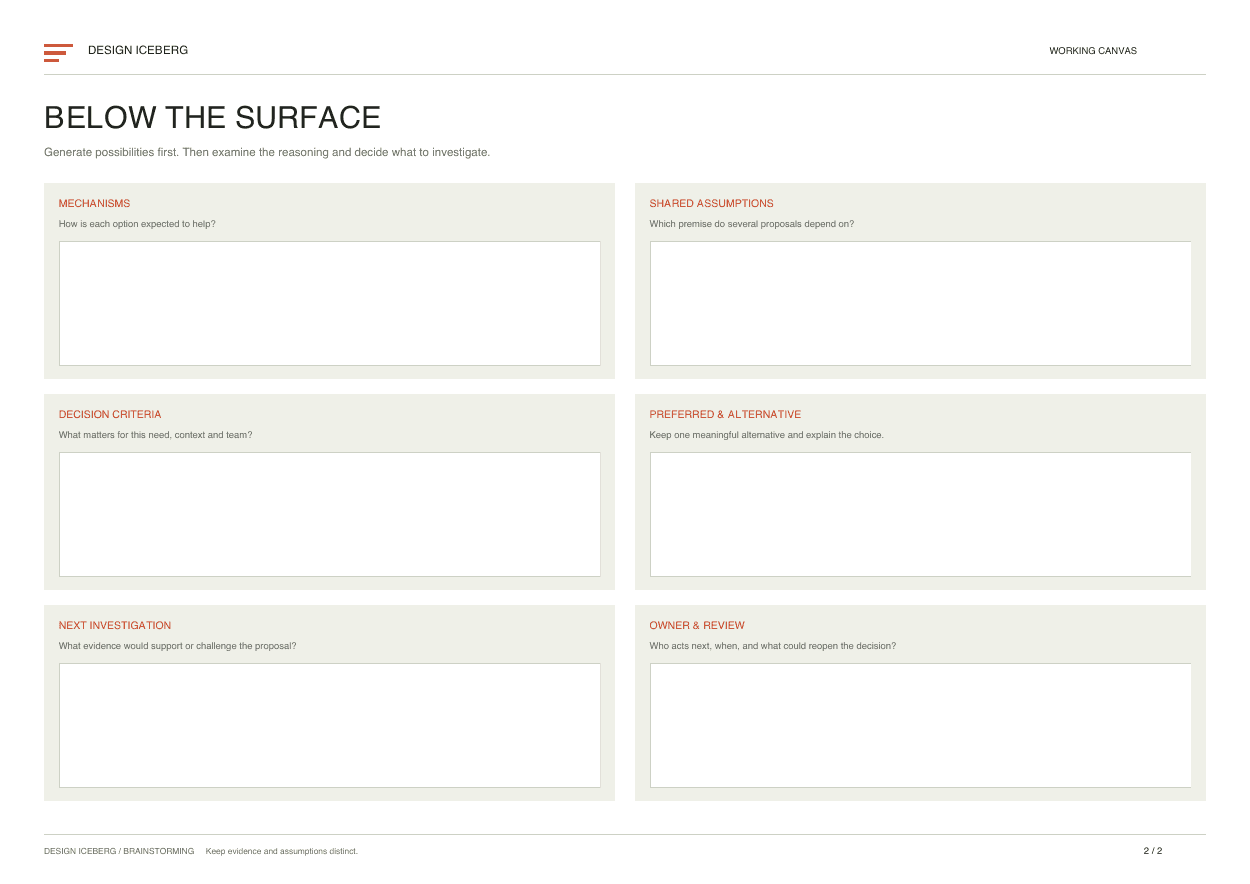
Brainstorming working canvas
Use the first page to frame the question and capture initial ideas, extensions and alternatives. Use the second page to compare mechanisms, expose assumptions and record the next investigation. The two page PDF supports typed notes and can also be printed for a workshop.

Practical tips
Keep the question visible throughout the session.
Invite people to explain a proposal before others critique it.
Retain the original notes when combining ideas so important differences remain traceable.
Common mistakes
Using brainstorming to compensate for missing research.
Letting the most senior participant define the preferred answer at the start.
Treating the number of notes as a measure of useful diversity.
Ending with a vote but no rationale or next investigation.
What you’ll get
A set of distinct proposals, their main assumptions and an agreed next investigation. Use Paper Prototyping to make an interaction tangible, or an Impact / Effort Matrix when the next decision requires comparing expected value and delivery effort.