01 / UNDERSTAND
What is card sorting?
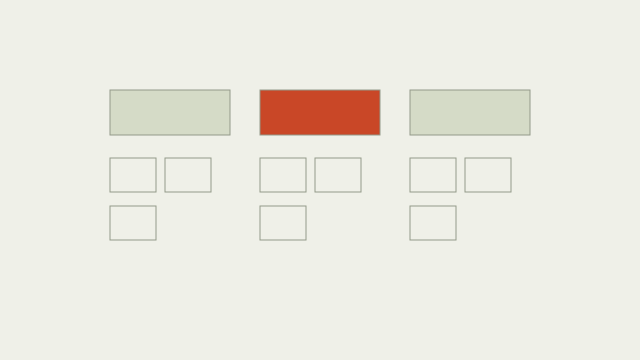
Card sorting explores how people group and label content. Participants organise cards representing topics or items so the team can examine their expectations. The result informs an information architecture; it is not a finished navigation. An open sort lets people create groups and names. A closed sort supplies categories. A hybrid sort combines supplied and participant created categories.
Why use Card Sorting?
A structure that follows internal departments may not match the way people look for information. Card sorting makes alternative groupings discussable and highlights items whose meaning or placement is unclear. It can suggest a structure to investigate, but sorting content in a study differs from finding something while completing a real task.
When to use it
USE IT WHEN
You are organising content or reviewing category labels.
Several plausible groupings need to be explored with relevant people.
An existing structure reflects the organisation more than user expectations.
When to choose another method
Use task based evaluation to check whether people can find information in a proposed structure.
Resolve unclear content scope before asking people to sort it.
Do not use a closed sort to claim participants invented the supplied categories.
What you’ll need
Prepare representative content cards with clear, comparable labels. Avoid giving away groupings through repeated category words. Recruit participants with relevant information needs and choose an open, closed or hybrid format based on the question. Pilot the instructions and card set. Record uncertainty and participant explanations as well as the final groups.
What the method needs
Keep the elements that help answer your question and support a decision.
What the team needs to understand about grouping or labels.
Representative items with understandable, comparable names.
Open, closed or hybrid, chosen for the question.
People whose information needs the structure must support.
Placements, names, ambiguous cards and explanations.
A reasoned interpretation to evaluate with finding tasks.
02 / PUT IT INTO PRACTICE
How to run a card sort
Keep evidence and assumptions distinct. Revisit your work when new information changes your understanding.
01
Define the question
Separate exploring groups from checking supplied categories.
Explore how learners organise information before joining a course.
02
Prepare the cards
Choose representative items and pilot the wording.
Include course dates, entry requirements, refunds and access support.
03
Choose the format
Use the format that can answer the question.
An open sort can reveal names the team had not considered.
04
Run the sort
Let participants organise items without teaching the intended structure.
Record where access support feels relevant to several groups.
05
Compare the reasoning
Look at recurring groupings and meaningful differences.
A label may be unclear even when people place it together.
06
Evaluate a proposal
Turn the evidence into a candidate structure and test finding tasks.
Check whether someone can find support before committing to a course.
Example: organising a course information site
Illustrative scenario: the groupings are invented. Learners sort course dates, entry requirements, refunds, fees and access support. One groups support with getting ready; another keeps it beside course selection because it affects whether a course is suitable.
The team does not settle the disagreement by choosing the largest group alone. It considers a clear support destination plus a contextual link from course pages, then evaluates both with realistic finding tasks. The sort suggests a need for more than one route; it does not prove that the proposed links will be noticed.

03 / BELOW THE SURFACE
Below the surface: a category can hide a timing difference
An item can belong in different places because people need it at different moments. Ask when the information matters, not only where it belongs. In the course example, support may affect initial choice as well as preparation.
01 / EVIDENCE
What is supported?
Which source or observation supports the current interpretation?
02 / LIMIT
What remains uncertain?
Which assumption would change the decision if it were wrong?
03 / ACTION
What happens next?
Who will investigate or test the next step, and when?
Preserve that explanation when interpreting the groups. A navigation hierarchy has to make choices, but contextual links can support other routes without duplicating or contradicting the content. Test those routes with actual tasks. This is an editorial interpretation of the illustrative case, not a universal rule that ambiguous items should appear everywhere.
Card Sorting template
Use the first page for the practical work and the second to challenge the reasoning before choosing a next step. The canvas follows this guide and keeps evidence, assumptions and decisions visible.
The two page PDF contains 13 editable fields. Open it in a PDF reader that supports forms and save a working copy.


Practical tips
Pilot labels before interpreting difficult placements.
Keep participant explanations with the grouping data.
Include unfamiliar and ambiguous items in the analysis.
Common mistakes
Treating the most common grouping as a complete site map.
Mixing content items and broad categories on the same card set.
Helping participants reproduce the team’s preferred structure.
What you’ll get
Grouping evidence and a proposed structure to evaluate. Keep the supporting evidence and unresolved questions with the output. Assign an owner to the next action and revisit the result when the underlying situation changes. The method supports judgement; the completed canvas is not proof that the proposed choice will work.